


After 176 Years, GSI Gets Its First Woman Chief in Varsha Ashok Aglawe
Varsha Ashok Aglawe has become the 54th Director General of the Geological Survey of India, the first woman to head the 176-year-old organisation.

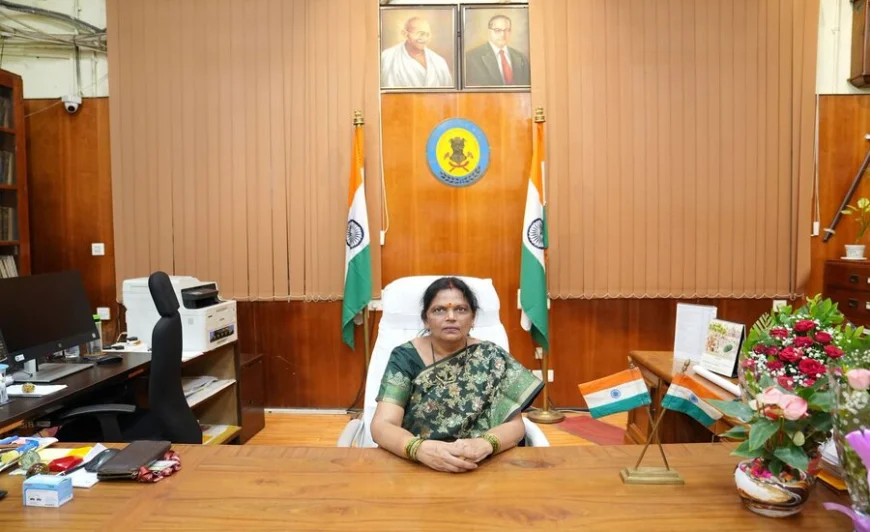
Varsha Ashok Aglawe has assumed charge as the 54th Director General of the Geological Survey of India, becoming the first woman to head the country's premier geoscientific organisation in its 176-year history. She succeeds Asit Saha, who served as Director General from July 27, 2024, to July 31, 2026.
The Geological Survey of India, established in 1851, is the government's primary agency for geological mapping, mineral exploration and natural hazard research, functioning under the Ministry of Mines. Its findings underpin everything from mining licences to disaster preparedness for landslides and earthquakes, and the organisation has taken on added weight in recent years as the government pushes to secure domestic supplies of critical minerals needed for electronics, defence and clean-energy manufacturing. The Director General's office sets the exploration agenda that determines which mineral belts get prioritised for survey work each year.
Aglawe joined the GSI in 1992 after an earlier stint with the Indian Bureau of Mines, and over more than three decades has worked across the organisation's Central, Northern and Eastern regions as well as at its Kolkata headquarters, moving between field-based scientific work and administrative leadership roles. Immediately before her present appointment, she served as Additional Director General and Head of Department for the Eastern Region in Kolkata. She is recognised within the geoscience community as a specialist in palaeontology and palynology, with published research on Late Cretaceous-Palaeocene sediments, the K-T boundary layer, and the Satpura-Gondwana basin systems, and is credited with helping identify the Salbardi-Ghorpend region in central India as a dinosaur nesting site.
Her predecessor Asit Saha led the GSI through a two-year term focused on expanding critical mineral exploration in line with national priorities. Aglawe takes over with the organisation already committed to an ambitious exploration calendar, and on assuming office she said the GSI would continue aligning its programmes with the government's critical mineral and mineral security goals, with a focus on deep-seated and concealed deposits that require advanced geophysical survey techniques rather than surface mapping alone.
Her appointment also arrives as the GSI looks to expand offshore mineral exploration and strengthen public-interest geoscience work such as natural hazard studies and glaciology, alongside efforts to increase scientific publications and build capacity among younger geoscientists entering the organisation. These priorities reflect a broader shift in the GSI's mandate from primarily land-based mineral mapping toward a wider remit covering climate-linked hazard research and the country's still largely unexplored offshore mineral resources.
As the first woman to lead an institution founded in 1851, Aglawe's appointment marks a milestone for representation within India's scientific administration, one that colleagues within the organisation have noted alongside her technical credentials in a field long dominated by male leadership.
The GSI's headquarters cadre and its six regional offices together employ thousands of geologists, geophysicists and chemists engaged in mapping mineral deposits, groundwater resources and geological hazards across the country. Aglawe's move from regional leadership in Kolkata to the top administrative post in Kolkata headquarters reflects the organisation's practice of drawing its Director General from among senior officers who have led its regional units, ensuring the incoming chief arrives with direct field experience rather than purely headquarters-based administrative exposure.
Her appointment also lands at a moment when India's mineral security push has taken on renewed urgency following global supply-chain disruptions affecting critical minerals such as lithium, cobalt and rare earth elements, several of which the GSI has been tasked with locating domestically to reduce import dependence for battery and electronics manufacturing.